
Health & Safety Training
AED (Defibrillator) Training Course
A half-day, in-company course that trains your staff to act in a cardiac arrest emergency: to give effective CPR and to use an automated external defibrillator (AED) safely and with confidence.
- ½ day · at your site
- In-company UK-wide
- KeyOstas operator certificate
- No prior experience needed
- Up to 12 delegates
Key facts at a glance
- ½ dayCourse lengthdelivered at your premises
- CPR + AEDWhat it coverslife support and defibrillation
- Any staffWho it is forno experience needed
- AnnualSuggested refresherkeeps the skills sharp
The course · Quick answer
What is AED training?
AED training is a short course that prepares staff to respond to a sudden cardiac arrest: to recognise it, start CPR, and use an automated external defibrillator. KeyOstas delivers it in half a day at your premises, and every delegate receives a KeyOstas AED operator certificate.
- Trains staff to recognise cardiac arrest and act fast
- Covers CPR, basic life support and safe AED use
- Suitable for any member of staff, with no prior experience
- KeyOstas AED operator certificate for every delegate
When someone goes into sudden cardiac arrest, their chance of survival falls with every minute that passes. Early CPR and early defibrillation are the two steps that save lives, and that is what this course trains your staff to deliver. An AED is designed to be safe and to guide its operator, but a trained, confident responder acts faster and more effectively. If your workplace has a defibrillator, or is thinking of getting one, training the people around it is what makes it count.
- ½ dayto a confident responder
- CPR + AEDthe two steps that save lives
- Annuala sensible refresher interval
Is it right for you
Is AED training right for your team?
It is for the workplaces that want people ready to act if a colleague collapses.
Right for you if…
- Your workplace has an AED, or is planning to install one
- You want a group of staff confident to respond to a cardiac arrest
- You would like nominated responders alongside your first aiders
- You want staff trained to give effective CPR
- You are inducting new starters or refreshing existing responders
A different course fits better if…
- You need full workplace first aid: see Emergency First Aid at Work or First Aid at Work
- You only need general health & safety awareness for staff
- You want a regulated, accredited qualification: this is a KeyOstas operator certificate
After the course
What you will be able to do
By the end of the half day, every delegate will be able to do the following.
Respond
Assess an emergency
Assess an emergency situation and take the appropriate action, including calling the emergency services.
Recognise cardiac arrest
Understand the basic anatomy of the heart and the common causes of cardiac arrest.
Give CPR
Demonstrate effective CPR and basic life support, and explain the chain of survival.
Care for the casualty
Demonstrate safe care of an unconscious casualty.
Use the AED
Use an AED safely
Demonstrate how to use the AED unit, and understand the safety points around it.
Define defibrillation
Explain what defibrillation is and why early defibrillation matters.
Maintain the AED
Carry out daily checks and routine care of the AED unit.
Report afterwards
Carry out post-incident reporting after using the AED.
Course content
What the course covers
A focused half day combining the theory with hands-on practice.
The heart & cardiac arrest
- Basic anatomy and physiology of the heart
- The common causes of cardiac arrest
- What defibrillation is, and the chain of survival
CPR & the casualty
- CPR and basic life support
- Care of the unconscious casualty
- Assessing an emergency and calling for help
Using the AED
- How to use the AED unit, and the safety points
- Care of the AED unit and daily checks
- Post-incident reporting
- Training and assessment methods
Assessment
How the course is assessed and certificated
Practical and hands-on, with no written exam.
Format
Instructor-led, in-company
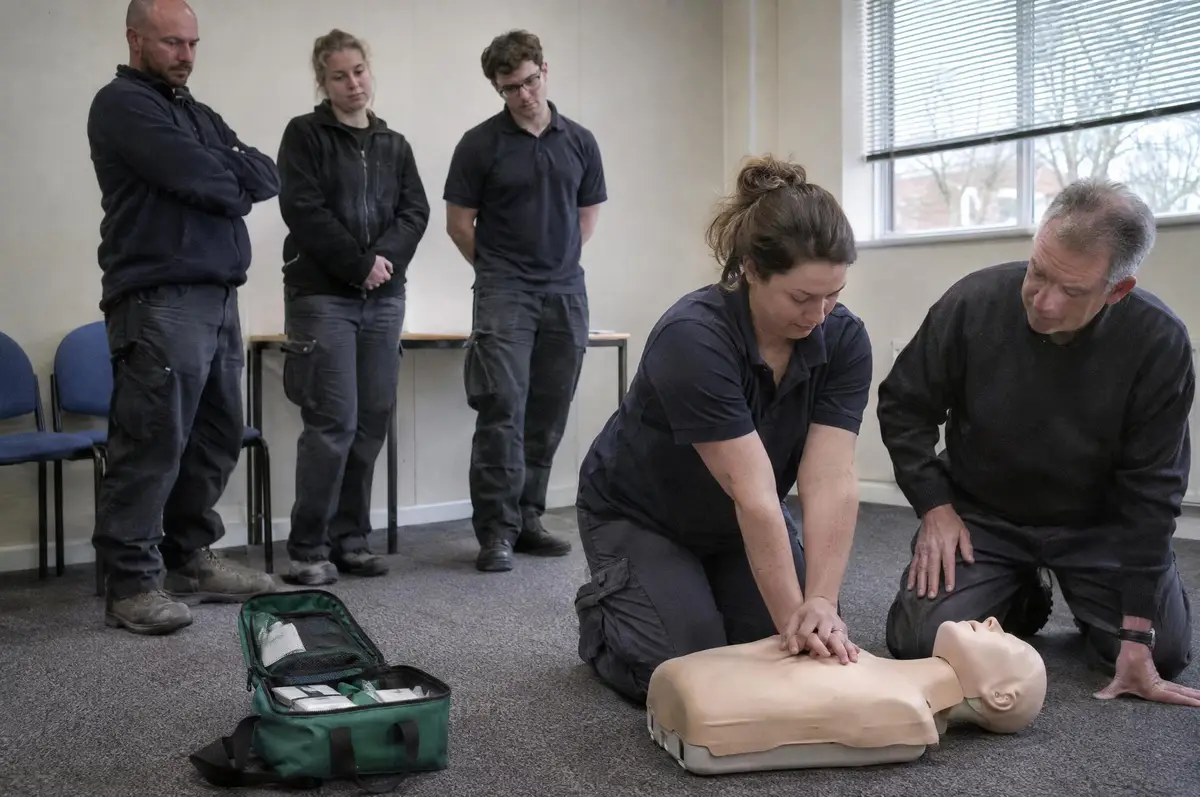
A KeyOstas tutor delivers the session at your premises, on training equipment or your own AED.
Assessment
Practical demonstration
Delegates are assessed on demonstrating CPR and safe AED use, rather than by a written exam.
Certificate
KeyOstas operator certificate
Every delegate receives a KeyOstas AED operator certificate on completion.
CPR and AED skills fade without practice. There is no fixed legal expiry, but an annual refresher is widely recommended so your responders stay confident and effective.
The numbers
Why minutes matter
- Every minutesurvival from cardiac arrest falls with each minute before defibrillation
- CPR + AEDtogether they give the best chance of survival
- ½ dayto train a confident workplace responder
- 1984KeyOstas has trained UK workforces in health & safety since
Why KeyOstas
Why train with KeyOstas
Practical, in-company health & safety training.
Delivered at your site
We come to you, anywhere in the UK, and train your team around your shift pattern.
Hands-on practice
Delegates practise CPR and AED use, so they are ready to act for real.
Trained on your AED
The session can use your own AED model so staff know the exact unit they would reach for.
Specialists since 1984
Training UK workforces with practical instruction, not generic e-learning.
Health & safety training
Related courses
Build a complete emergency-response capability across your team.
First aid
Emergency First Aid at Work
The one-day course covering the emergency first aid skills every workplace needs.
View the courseFirst aid
First Aid at Work
The full three-day first aid course for appointed workplace first aiders.
View the courseFirst aid
First Aid at Work Requalification
The shorter requalification course for first aiders renewing their certificate.
View the courseFAQ
AED training: frequently asked questions
Is AED training a legal requirement?
There is no specific law requiring AED training on its own. However, if your workplace has a defibrillator, the people who might use it should be trained, and your first-aid needs assessment under the Health and Safety (First-Aid) Regulations may point to having one.
How long is the course?
Half a day, delivered in-company at your premises.
Do we need our own defibrillator for the course?
No. The course is delivered using training equipment. If you have your own AED we can train on that model so staff are familiar with the exact unit.
Is an AED safe for a trained person to use?
Yes. An AED is designed to be safe: it analyses the casualty's heart rhythm and will only allow a shock to be delivered when one is needed. Training builds the confidence to use it quickly and correctly.
How often should AED training be refreshed?
CPR and AED skills fade with time. There is no fixed legal interval, but an annual refresher is widely recommended.
Is AED training the same as first aid training?
No. AED training focuses on cardiac arrest, CPR and using a defibrillator. Full workplace first aid is broader: see Emergency First Aid at Work or First Aid at Work.
Who should attend?
Any member of staff. It is well suited to nominated responders, and to teams in workplaces that have, or are installing, an AED.
Do delegates get a certificate?
Yes. Every delegate receives a KeyOstas AED operator certificate on completion.
Cancellation terms for in-company courses
Notice of cancellation is required in writing.
Telephone cancellations will be accepted but be confirmed in writing within seven (7) days. Substitution of delegates will incur no charge.
The amount of the course fee that is still applicable will be determined as standard according to the following rules:
| Cancellation Notice | Fee Payable: | If transferred to later date: |
|---|---|---|
| No Show | FULL | FULL |
| 5 days or less | FULL | FULL |
| 6 to 10 days | 75% | 50% |
| 11 to 15 days | 50% | 25% |
| 16 to 20 days | 25% | 10% |
For NEBOSH and IEMA Courses:
| Cancellation Notice | Registration Fees Payable: | If transferred to later date: |
|---|---|---|
| 30 days or less | FULL | FULL |
N.B. Days = Working Days
Upon receipt of completed Booking Form an Invoice and Course Joining Instructions will be issued.
TERMS: STRICTLY 30 DAYS NET FROM INVOICE DATE (unless otherwise agreed)

Train your team to use your defibrillator
Tell us how many people you would like to train and the AED model you use, and we will put together a quote for the half-day course delivered at your site.
Request a quoteAll health & safety courses
Last reviewed: May 2026. Checked against current UK health & safety legislation and HSE guidance.